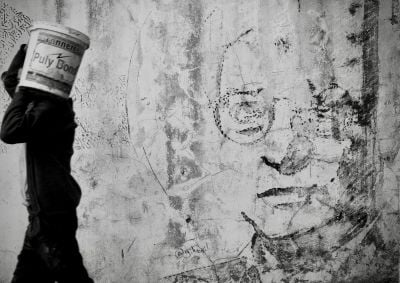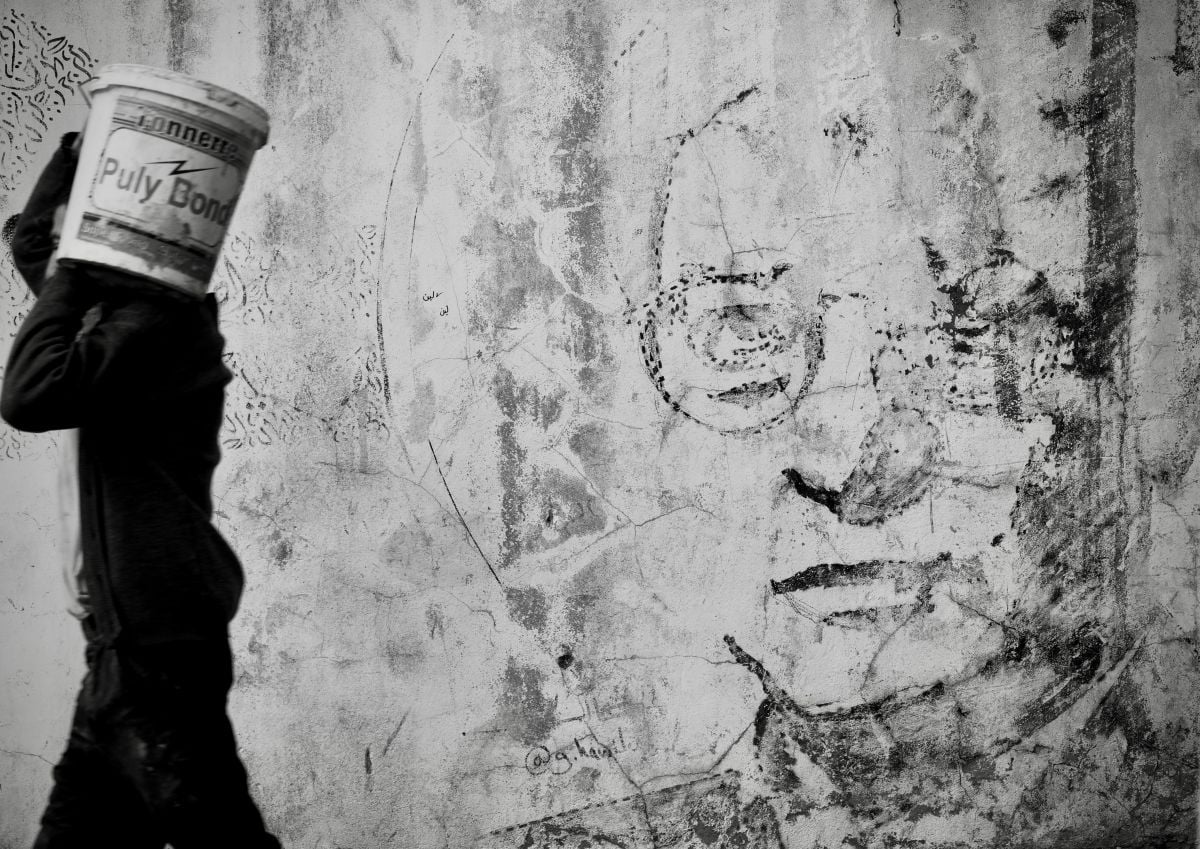
A man walks past a graffiti depicting Palestinian poet Mahmoud Darwish, on Jan. 16, 2023 in the city of Sour, Southern Lebanon. (Credit: Matthieu Karam/L’Orient-Le Jour)






It is the story of an extraordinary encounter between immense talent, a cause, and an era. Mahmoud Darwish embodied this like few other contemporary Arab poets; his words became intimately entwined with the destiny of a people, while also resonating far beyond their borders.
Because he gave a voice to those condemned to silence; because he granted the Palestinian experience of dispossession and exile a singular poetic power; because he was the national poet of a people who struggle every day to exist and not be crushed by the Israeli death machine; because his verses spoke of being torn from the land, of fidelity to memory, and of hope for return; and finally, because he made the Palestinian cause a universal one — the cause of all the defeated who persist in defending their dignity: Mahmoud Darwish remains an irreplaceable voice.
On the occasion of Mahmoud Darwish Poetry Day — an international tribute to the poet who died in 2008, organized by the Centre Georges Pompidou and the Arab World Institute (both based in Paris) from Sept. 25 to 27 — L’Orient-Le Jour is dedicating a special feature to the legacy of this iconic and extraordinary figure in Arab and world literature.
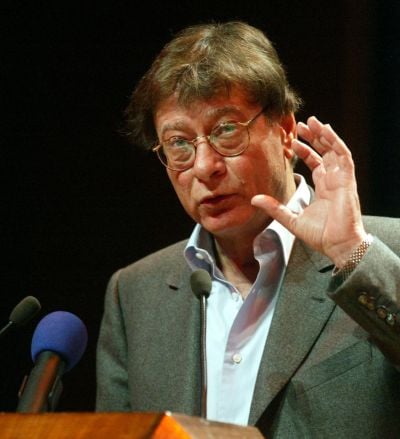
A symbol of a thwarted homeland, he was also a free and elusive man, rebellious to dogmas and heavy-handed solemnities. Eminently political, he nonetheless claimed the right to “read the rose as a rose,” to grasp the sensations, tastes, and colors of everyday life, to speak of love, thus refusing to reduce the oppressed to their oppression, to an abstract idea marching in step. “We are certainly engaged in a long and difficult struggle that requires the poet to play a role in shaping national identity, but we must insist on our right to meditate on our human nature,” he summed up in an interview with the Lebanese poet Abdo Wazen in 2005. “We are not a political discourse, we are not a leaflet. And, as I have often repeated, being Palestinian is not a profession.”
“We will be a people when we can insult the sultan and the sultan’s chamberlain without being judged,” he writes in the poem "If We So Wish." “We will be a people when we forget what the tribe tells us... when the individual focuses on the small details. We will be a people when the writer looks at the stars without saying: ‘Our homeland is still higher... and more beautiful!’”
Clarity and pessimism
Seen from Lebanon, it is impossible to evoke Darwish without mentioning Beirut, the city where he lived from 1972 and which he had to leave after the Israeli siege in 1982. “I still feel a great nostalgia for this city. I am sick with Beirut, without being able to determine the exact reasons for this love,” he confided, again in 2005. In "Memory for Forgetfulness," he recounts a day in August in the bombed capital: the deafening noise of airplanes, the gut-wrenching fear, the waiting, but also the stubbornness of making coffee. Small gestures that reveal the lives threatened by war. “But the one who happened to be on the terrace only had to shake the dust from his clothes and jump onto the street, without having to take the elevator, as the building had been reduced to a pile of rubble barely higher than the ground...”
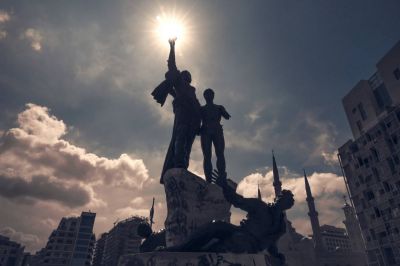
On the Palestinian experience in Lebanon, the poet demonstrated great clarity very early on. When Abdo Wazen asked him if he felt “committed to the Lebanese war,” he — who had belonged to the PLO — replied that he had always been pessimistic regarding Palestinian involvement in Lebanon’s divisions, while also rejecting the interpretation that made them solely responsible for the country's suffering. “I was ashamed when I saw Palestinian checkpoints and fighters asking Lebanese citizens for their identity papers... Of the questions I asked myself, this one particularly haunted me: what interest do we have in achieving victory in Lebanon? Let’s imagine the war ends and we come out as victors? What would we do then? Occupy Lebanon? Take power?”
Words and bulldozers
Reading or rereading Mahmoud Darwish at a time when Israel is trying to complete its colonial conquest of the entire historic Palestine, when Gaza is annihilated, the West Bank is subjected to daily settler barbarism, and southern Lebanon is devastated, depopulated, and occupied, can sometimes give us the desperate feeling that, in this part of the world, history is marching backward — equipped with the weapons of present-day destruction.
Certainly, neither poetry, nor literature, nor the arts in general can do anything against bulldozers, airplanes, or AI pressed into the service of the worst. But in a region where hope is eaten away by the premonition of a cursed destiny, Mahmoud Darwish gives us words when it seems there is nothing left to say. And if the land is increasingly narrow — as the poet’s famous line goes — for Palestinians and many Lebanese, “what is worth living for” still survives there, and always will.
In our special addition:
“Mahmoud Darwish: A battle for identity, against oblivion," by Raef Zreik, a political philosophy and philosophy of law specialist. On the occasion of Mahmoud Darwish Poetry Day, he examines how Mahmoud Darwish anchors the Palestinian tragedy in the common memory of the defeated and makes poetry a homeland capable of resisting erasure and oblivion.
The original version of this text, in Arabic, is here.
“Nothing but the light" by Hala Mohamad, a Syrian poet and filmmaker born in Latakia. In this text, she reflects on the influence of Mahmoud Darwish’s poetry in her life, how it keeps hope, the memory of Palestine, and the desire for freedom alive in human consciousness.
The original version, in Arabic, is here.
This article also appeared in French on L'Orient-Le Jour.